Written by Human & AI
Table of contents
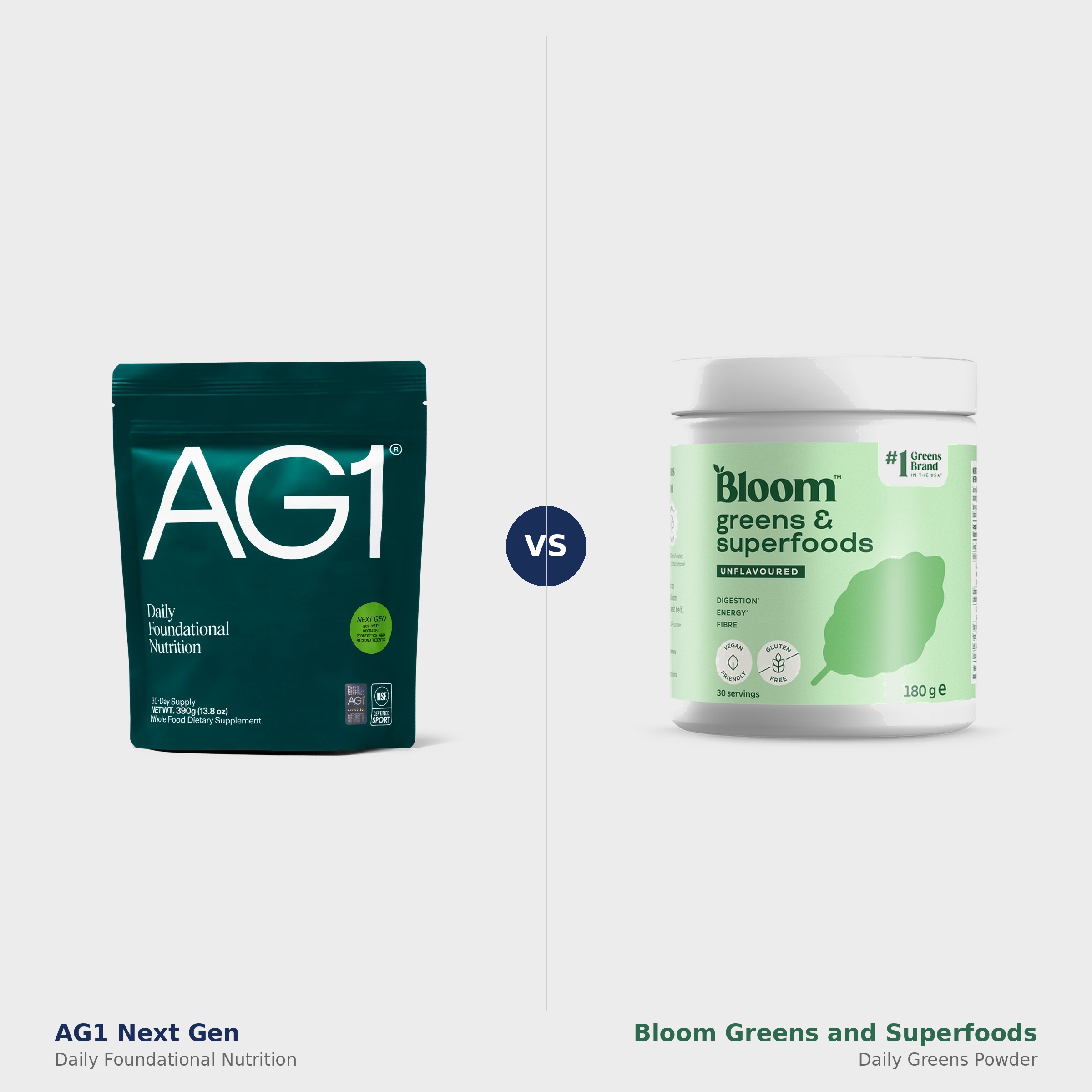
AG1 and Bloom Greens represent two different approaches to the greens powder category. AG1 has built its reputation through podcast sponsorships and athlete endorsements, positioning itself as the premium all-in-one daily supplement with 83 ingredients and NSF Sport certification. Bloom Greens entered the market through TikTok and Instagram, capturing Gen Z consumers with fruity flavours and an accessible price point of around $35 per month compared to AG1’s $79 monthly subscription.
The core difference comes down to ingredient depth and third-party verification versus taste and affordability. AG1 delivers 7.2 billion CFU probiotics, adaptogens, digestive enzymes, and extensive vitamin coverage backed by NSF Sport testing. Bloom Greens offers a simpler formula focused on gut health with strong taste ratings but no NSF certification and a lower probiotic count.
Both products qualify as legitimate greens supplements, but they serve different needs. AG1 functions as a comprehensive daily supplement that can replace multiple bottles in your cabinet. Bloom Greens works as an entry-level greens powder that prioritises palatability and cost over formula complexity. For a broader look at where both products sit in the market, see our full AG1 review.
Key takeaways
- AG1 provides superior ingredient depth with 83 components, NSF Sport certification, and 7.2 billion CFU probiotics compared to Bloom’s simpler formula.
- Bloom Greens wins on taste and mixability while costing less than half of AG1’s monthly price.
- AG1 serves as a complete daily supplement replacement while Bloom functions as an affordable greens-focused addition to an existing routine.
Key differences at a glance
| Category | AG1 | Bloom Greens |
| Price (subscription) | $79/mo ($2.63/serving) | ~$35/mo ($1.17/serving) |
| Serving size | 12g per scoop | 5.7g per scoop |
| Ingredients | 83 ingredients | 30+ ingredients |
| Probiotics | 7.2 billion CFU | 2.5 billion CFU (select flavours only) |
| Digestive enzymes | Bromelain, amylase, protease, lipase, cellulase | Amylase, protease, cellulase, lipase |
| Adaptogens | Ashwagandha, rhodiola, mushroom complex | Ashwagandha, rhodiola, ginseng (100mg total blend) |
| NSF Sport certified | Yes | No |
| Vitamin transparency | Full label disclosure | Minimal — calories, fibre, iron, sodium only |
| Best for | Comprehensive daily nutrition, athletes | Taste-first users, gut health basics, budget buyers |
Price and value overview
AG1 costs $79 per month with a subscription, while Bloom Greens runs approximately $35 per month. That is more than double the price for AG1. Each AG1 pouch contains 30 servings at 12 grams per serving. Bloom provides 30 servings at 5.7 grams per serving, making it a notably smaller serving size overall.
The price difference reflects distinct formulation approaches. AG1 positions itself as a comprehensive daily nutrition solution with 83 ingredients packed into each larger serving. Bloom focuses on affordability and taste with a more streamlined ingredient list that keeps costs down. For budget-conscious consumers, Bloom offers better value per dollar. For those prioritising ingredient breadth and higher doses of key compounds, AG1’s premium pricing reflects its more ambitious formula.
It is also worth considering what AG1 replaces. If it consolidates a multivitamin ($15 to $30 per month), a probiotic ($20 to $40 per month), and a greens powder ($30 to $50 per month), the $79 cost may actually represent a saving. Bloom Greens covers greens and basic digestive support but does not fully replace a comprehensive multivitamin or standalone probiotic. Users who choose Bloom typically need to stack other supplements alongside it to match AG1’s coverage.
Probiotics and enzyme complexes
AG1 delivers 7.2 billion CFU of probiotics per serving with a full digestive enzyme blend including bromelain, amylase, protease, lipase, and cellulase, plus prebiotic fibre from inulin and beta-glucans. This combination supports gut bacteria growth and may help ease gas and bloating.
Bloom Greens contains three probiotic strains, but most flavours do not list the CFU count on the label. Only Watermelon and Pineapple flavours specify 2.5 billion CFU, which falls on the lower end of the recommended 1 to 10 billion range. Bloom includes multiple digestive enzymes and blue agave inulin for gut health, though the lack of dosage transparency makes it difficult to assess effectiveness compared to AG1’s clearly stated amounts.
The probiotic difference is significant for those prioritising digestive support. AG1’s 7.2 billion CFU falls comfortably within the clinically studied range for daily gut health. The fact that most Bloom flavours do not disclose their CFU count at all means users cannot verify they are getting a meaningful dose.
Certifications and testing standards
AG1 holds NSF Certified for Sport status, undergoes third-party testing, and is manufactured in GMP-certified facilities. This certification confirms the product is free from over 270 banned substances and meets strict quality standards. It is one of the most rigorous third-party testing programmes available for dietary supplements and is required for tested athletes.
Bloom states its products are rigorously tested and manufactured in GMP-certified facilities, but it does not hold NSF Certified for Sport status. GMP certification is a standard manufacturing requirement, not an independent quality verification of the kind NSF provides. Both brands follow good manufacturing practices, but AG1’s additional layer of independent verification provides stronger quality guarantees and explains part of the price premium.
Deep dive: AG1's comprehensive approach

Ingredient profile
AG1 contains 83 ingredients across multiple functional categories. The formula includes organic greens like spirulina, chlorella, wheatgrass, and barley grass powder, all known for their nutrient density. The mushroom complex features reishi and shiitake mushrooms to support immune function and stress response. The adaptogen blend incorporates rhodiola and ashwagandha at meaningful concentrations.
AG1's fruit and vegetable blend provides polyphenols and beta-carotene from whole food sources, including beetroot powder for nitric oxide support and barley grass for chlorophyll content. The formula contains prebiotics like inulin and fibre from apple powder to feed beneficial gut bacteria. Athletic Greens lists all vitamins and minerals with specific quantities, which gives users a clear picture of what each serving delivers. For the full breakdown, see our full AG1 review.
Probiotic and enzyme potency
AG1 delivers 7.2 billion CFU of dairy-free probiotics across multiple strains per serving. This concentration sits comfortably within the clinically effective range for daily gut health support. The digestive enzyme blend contains bromelain, amylase, protease, lipase, and cellulase, which help break down proteins, fats, carbohydrates, and plant fibres for better nutrient absorption.
Athletic Greens includes both prebiotics and probiotics, creating a synbiotic effect. The inulin and fibre content feeds the probiotic strains, helping them colonise more effectively in the digestive tract.
Certifications and brand transparency
AG1 holds NSF Certified for Sport status, confirming the product is free from over 270 banned substances. Athletic Greens manufactures in GMP-certified facilities and conducts batch testing for purity. The company publishes detailed information about its testing protocols and ingredient sourcing, and provides certificates of analysis on request.
The transparent labelling approach shows exact amounts for vitamins and minerals rather than hiding behind proprietary blends for these core nutrients. AG1 has undergone 52 formula iterations since 2010, with each version backed by research and testing. The brand also offers a 90-day money-back guarantee on first orders.
Inside Bloom Greens: a social media sensation

Ingredient simplicity and focus
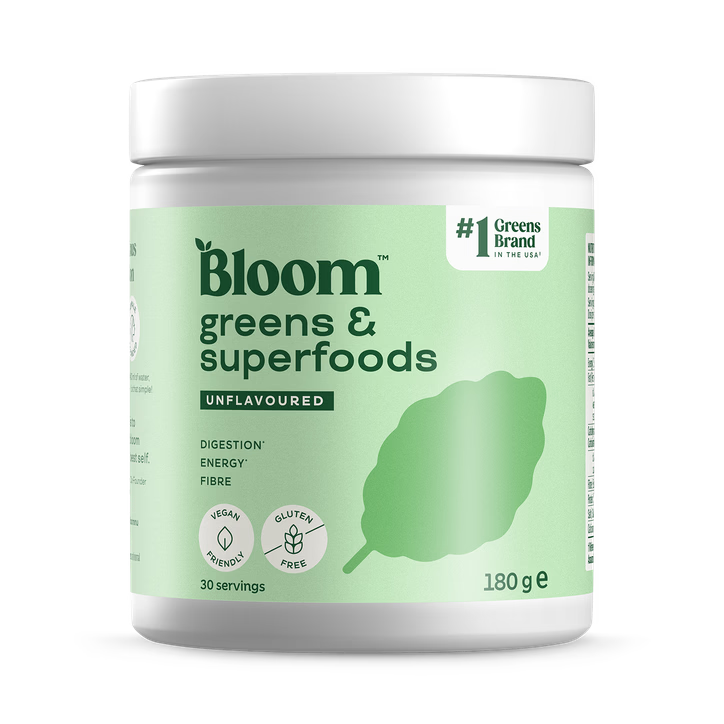
Bloom Greens uses a streamlined approach across five main blends. The greens blend includes spirulina, chlorella, wheatgrass, barley grass, and alfalfa. The fruit and vegetable blend adds beetroot powder, carrot, blueberry, spinach, broccoli, and kale for beta-carotene and phytonutrients. The formula includes chicory root as both a fibre source and prebiotic, three probiotic strains, and a digestive enzyme blend containing amylase, protease, cellulase, and lipase.
Bloom also includes adaptogens, but the entire adaptogenic blend totals only 100mg across ashwagandha, rhodiola, and ginseng. At that total weight, it is unlikely any single ingredient reaches a clinically effective dose. The smaller 5.7 gram serving size means every ingredient receives less space than in AG1's larger 12 gram scoop, which limits the dose of individual components across the board.
Taste and mixability appeal
Bloom offers more than eight flavour options including Berry, Mango, Coconut, and Citrus. The flavours are sweet and fruity, designed to taste more like a smoothie than a greens supplement. This makes daily use easier for people who dislike earthy or grassy flavours. The powder mixes smoothly in water, milk alternatives, or blended drinks, with users reporting minimal clumping and no gritty texture. The flavour variety also helps prevent supplement fatigue.
Formulation highlights for gut health
Bloom positions itself as a gut-focused greens supplement. The combination of prebiotics from chicory root and three probiotic strains supports digestive balance, and the digestive enzymes help break down macronutrients. The formula is gluten-free and uses stevia as a sweetener with zero sugar. However, ingredients are not certified organic and the probiotic CFU count is not disclosed across most flavours.
At approximately $35 per month, Bloom costs less than half of premium greens powders. The lower price reflects the smaller serving size and fewer total ingredients, but it makes the product accessible to budget-conscious consumers who want basic greens coverage.
Ingredient comparison: depth, quality, and transparency
Probiotic strains and potency
AG1 provides 7.2 billion CFU of probiotics across multiple strains including Lactobacillus acidophilus and Bifidobacterium bifidum with guaranteed potency at consumption. Research suggests effective probiotic supplements typically deliver 1 to 10 billion CFU daily depending on the strain and intended benefit. AG1's transparent labelling of 7.2 billion CFU falls squarely within this evidence-based range.
Bloom Greens includes probiotics and prebiotics but does not disclose CFU counts on most of its flavour labels. Without a stated CFU number, users cannot verify they are getting a meaningful dose. The 2.5 billion CFU stated on select Bloom flavours is a reasonable amount but still falls below AG1's count, and the inconsistency across flavours makes it harder to rely on as a gut health product.
Adaptogen and phytonutrient content
AG1 includes a broad adaptogen profile with ashwagandha, rhodiola, and a mushroom complex featuring reishi. These adaptogens support stress response and recovery. The formula delivers phytonutrients through spirulina, chlorella, and barley grass at higher concentrations due to the larger 12 gram serving size.
Bloom Greens contains ashwagandha, rhodiola, and ginseng in its adaptogen blend, but the entire blend totals only 100mg. Research on ashwagandha alone typically uses 300 to 600mg daily for meaningful stress reduction effects. A 100mg total blend across three adaptogens is unlikely to deliver clinically relevant doses of any individual compound.
Digestive enzyme blends and fibre
Both products include digestive enzyme blends to support nutrient absorption. AG1's blend contains bromelain, cellulase, amylase, lipase, and protease. Bloom provides a similar profile with amylase, protease, cellulase, and lipase. The enzyme selection is comparable between the two products. The meaningful difference is in overall serving context. AG1's larger 12 gram serving means the enzymes work alongside more fibre, greens, and phytonutrients per scoop.
Transparency in proprietary blends
AG1 discloses specific amounts for all vitamins, minerals, and the probiotic count, which lets users verify they are getting clinically relevant doses. Bloom Greens relies more heavily on proprietary blends without disclosing individual ingredient amounts beyond basic nutritional information. The label shows blend totals but not how much ashwagandha, spirulina, or other specific ingredients each serving contains. This makes it impossible to compare Bloom's doses against research-supported levels.
Taste, user experience, and mixability
Flavour profiles and user preferences
Bloom Greens offers more than ten fruity flavour options that users consistently praise for tasting sweet and pleasant without being overly artificial. The product was designed with taste as a priority, which shows clearly in customer feedback across the social media platforms where it gained its following. It is genuinely one of the better-tasting greens powders on the market.
AG1 has a grassier, earthier flavour that tastes more like concentrated vegetables and greens. Many users describe it as an acquired taste that takes adjustment over the first week or two. Some mix it with coconut water or add it to smoothies to soften the natural green flavour. The vanilla notes help, but it remains more vegetal than Bloom. This is not a weakness unique to AG1, it is the trade-off that comes with packing 83 ingredients including significant amounts of greens into a single serving.
Texture and everyday mixability
Bloom Greens has a smaller serving size at 5.7 grams compared to AG1's 12 grams, which means less powder to incorporate into liquid. Bloom mixes more smoothly with just a spoon in most cases. The finer powder consistency and smaller serving size contribute to easier preparation. Users find it blends well into water alone without needing additional ingredients to improve drinkability.
AG1 requires more vigorous mixing or shaking to prevent clumping. Users report best results using a shaker bottle rather than just stirring with a spoon. The larger serving size means more volume to dissolve. Neither product leaves significant sediment when mixed properly.
Digestive responses
AG1's higher probiotic content at 7.2 billion CFU can initially cause mild gastrointestinal discomfort in some users as their gut adjusts to the daily supplement routine. This typically resolves within a few days. Most users report improved energy and digestive regularity after this adjustment period. Bloom Greens generates fewer initial digestive complaints, likely due to its lower probiotic count and simpler formula. It tends to be the gentler option for those with sensitive digestion.
Cost analysis and value for money
Monthly cost per serving
AG1's subscription model runs $79 for a 30-day supply, working out to $2.63 per serving. Bloom Greens costs around $35 for 30 servings at $1.17 per serving. Users can also purchase a 60-serving Bloom container for roughly $70, lowering the per-serving cost to about $1.16. The price difference is clear. AG1 costs more than twice as much per serving.
Supplement value replacement
AG1 includes 83 ingredients across vitamins, minerals, probiotics, adaptogens, and digestive enzymes. If AG1 replaces a multivitamin ($15 to $30 per month), a probiotic ($20 to $40 per month), and a greens powder ($30 to $50 per month), the $79 cost may represent a genuine saving over buying each product separately. Bloom Greens focuses primarily on greens, antioxidants, and digestive support and does not fully replace a comprehensive multivitamin or standalone probiotic supplement. Bloom works best as a single addition to a routine rather than a consolidation tool.
Subscription models and money-back policies
Both brands offer subscription models. AG1 provides a 90-day money-back guarantee on first orders, giving users three full months to test the product. Bloom Greens offers standard return policies through most retailers but does not advertise the same extended guarantee. Bloom provides subscription options with 10% discounts on recurring orders. AG1's longer guarantee period reduces purchase risk for first-time buyers considering the higher price point.
Who should choose AG1 or Bloom Greens?
AG1: best for nutrition-first users
AG1 makes sense for people who want a complete daily supplement that replaces multiple products. The 83-ingredient formula includes 7.2 billion CFU probiotics, adaptogens, and a full digestive enzyme blend in clinically relevant doses. Users who already take separate multivitamins, probiotics, and greens powders can consolidate their routine into one scoop and potentially save money doing so.
The NSF Certified for Sport verification matters most to tested athletes and competitive professionals, but it also signals a higher standard of quality control for any consumer who wants independent proof of what they are consuming. AG1 suits users who treat their daily supplement as a serious health investment and who value ingredient depth, transparent dosing, and rigorous third-party testing.
Bloom: best for taste and first-time users
Bloom Greens works best for people new to greens powders who want an easy entry point. The fruity flavours make it simple to stick with the habit daily, which matters more than ingredient density if the taste barrier is what stops you from taking it consistently. At roughly $35 per month, Bloom removes the financial barrier that stops many people from trying greens powders for the first time.
The product resonates strongly with Gen Z users and social media audiences, and the gut health focus makes it a reasonable standalone purchase for someone who already takes a good multivitamin and a separate probiotic. If you are just looking to add vegetable-based nutrients and basic digestive support to an existing supplement routine without overhauling it, Bloom delivers solid value at an accessible price.
Choosing based on lifestyle, goals, and budget
Budget-conscious users and those new to greens powders will find Bloom the more sensible starting point. The $35 monthly cost makes it accessible and the taste profile supports long-term consistency, which is the most important factor for any supplement. Performance-focused users, competitive athletes, and anyone who wants to consolidate their supplement routine will find AG1 the stronger investment. The verified formula, higher probiotic count, NSF Sport certification, and broader ingredient coverage justify the premium for users who will genuinely use what it offers. Anyone who has been putting off greens powders specifically because of the taste should also consider Bloom first.
Final verdict: which greens powder delivers more?
AG1 is the stronger daily supplement for anyone prioritising formula depth, third-party testing, and comprehensive nutrition. The 83-ingredient formula includes individually listed vitamins and minerals, 7.2 billion CFU probiotics, a full digestive enzyme blend, and adaptogens at meaningful serving sizes. NSF Certified for Sport testing adds accountability that matters both for athletes and for any consumer who wants independent verification of what they are putting in their body.
Bloom Greens offers a legitimate gut-focused formula at less than half the price. The taste consistently beats AG1 in user reviews, the flavour variety is genuinely impressive, and the social proof is real. But it lacks the probiotic dose, full adaptogen support, vitamin transparency, and third-party certifications that define a premium greens powder. The 100mg total adaptogen blend and undisclosed CFU count across most flavours are genuine limitations worth knowing about.
For someone building a daily supplement foundation who wants to replace multiple products with one scoop, AG1 justifies the cost. For someone focused on gut health and taste who plans to stack other supplements separately, Bloom delivers solid value. For a broader comparison of both products against the full greens powder market, see our best greens powders roundup.
AG1 wins on
- Formula completeness (83 vs 30+ ingredients)
- Probiotic potency (7.2 billion CFU vs 2.5 billion CFU in select flavours only)
- NSF Certified for Sport testing
- Full vitamin and mineral label disclosure
- Adaptogen inclusion at meaningful serving sizes
- 90-day money-back guarantee
Bloom wins on
- Price ($35/mo vs $79/mo)
- Taste and flavour variety (10+ options vs 4)
- Mixability and ease of preparation
- Gentler introduction for sensitive digestion
- Accessibility for first-time greens powder users
Frequently asked questions
Is Bloom Greens as effective as AG1 for daily nutrition support?
AG1 provides more comprehensive daily nutrition support due to its 83-ingredient formula compared to Bloom's 30-plus ingredients. The formula includes a broader range of vitamins, minerals, and phytonutrients designed to fill nutritional gaps, with all vitamins and minerals listed at exact amounts on the label. AG1 contains higher probiotic doses at 7.2 billion CFU per serving. Bloom lists 2.5 billion CFU in only some flavours, with other varieties not disclosing their probiotic count at all. AG1 has also undergone 52 formula iterations since 2010, compared to Bloom Nutrition which launched in 2019 with a simpler formula focused primarily on gut health and taste.
How do the probiotic strains and CFU counts compare between the two products?
AG1 delivers 7.2 billion CFU of dairy-free probiotics in every serving across multiple documented strains including Lactobacillus acidophilus and Bifidobacterium bifidum. This falls comfortably within the recommended range for daily probiotic supplementation. Bloom Greens contains 2.5 billion CFU in certain flavours like Watermelon and Pineapple, but many other Bloom flavours do not list their CFU count on the label, making it impossible to verify probiotic potency across the product line. AG1 also includes a full digestive enzyme blend with bromelain, amylase, protease, lipase, and cellulase. Bloom offers multiple digestive enzymes in its formula, though the exact amounts are not disclosed.
Which option offers stronger third-party testing and sport-related certifications?
AG1 holds NSF Certified for Sport certification, one of the most rigorous third-party testing standards in the supplement industry. This confirms the product is free from banned substances and that every batch is independently verified. Bloom Greens does not have NSF Sport certification. The company states its products are rigorously tested and manufactured in GMP-certified facilities, but GMP certification is a standard manufacturing requirement rather than an independent third-party quality verification of the kind NSF provides. Athletes and individuals subject to drug testing should choose AG1. Bloom may be suitable for general wellness but lacks the verification required for competitive sport.
What are the biggest differences in ingredient breadth, adaptogens, and digestive enzymes?
AG1 contains 83 total ingredients including a mushroom complex with reishi and shiitake. Bloom offers 30-plus ingredients with no mushroom varieties. The adaptogen content differs meaningfully between the two formulas. AG1 includes ashwagandha and rhodiola at serving sizes designed to support stress response. Bloom contains ashwagandha, rhodiola, and ginseng but the entire adaptogenic blend totals only 100mg, which is unlikely to deliver clinically effective doses of any single adaptogen. Both products include digestive enzyme blends. AG1's blend contains bromelain, amylase, protease, lipase, and cellulase. Bloom includes a similar enzyme profile without disclosing individual amounts.
Which greens powder tastes better and mixes more smoothly?
Bloom Greens wins on taste and mixability. The 10-plus fruity flavour options effectively mask the earthy taste of greens, making it more palatable for daily use. AG1 has a strong, earthy flavour profile that most users describe as an acquired taste. Many mix it with coconut water or blend it into smoothies to improve drinkability. Both products use stevia as a sweetener, though Bloom's flavour masking is more effective. In terms of mixability, Bloom's smaller 5.7 gram serving dissolves more easily than AG1's 12 gram scoop. AG1 requires a shaker bottle for best results, while Bloom can be mixed adequately with just a spoon.
How does the monthly cost compare, and which delivers better value?
AG1 costs approximately $79 per month on subscription at $2.63 per serving. Bloom Greens costs around $35 per month at $1.17 per serving, making it less than half the price. AG1 justifies its higher price through its larger ingredient count, higher probiotic CFU, NSF Sport certification, full vitamin and mineral label transparency, and a 90-day money-back guarantee. Bloom provides better value for budget-conscious consumers who prioritise gut health and basic greens supplementation as a standalone addition to their routine. The value question depends on what each product replaces. AG1 can consolidate a multivitamin, probiotic, and greens powder into one subscription, which changes the cost comparison significantly for users currently buying all three separately.